Showing posts with label Muslim Women Writers. Show all posts

Friday, May 3, 2013

Storyteller's Daughter by Saira Shah


Below is a short response I wrote about the Storyteller's Daughter by Saira Shah. I had to read the book for my Muslim Women Writer's class. My main issue with this book is a serious one. Since it is written in a way that is accessible and entertaining to the general Western population, I think it could help readers justify the US intervening in Afghanistan both during the Marxist Revolution and, later, to fight the Taliban. Additionally, she leaves out a huge part of the historical and political contest making it easy for the general reader to overlook the complexities she presents about Afghan society.
Here is the link to a documentary also made by Saira Shah called "Beneath the Veil."


While the book is interesting to read, I have several questions about the author’s motives and political alliances and what purpose this book is supposed to fulfill for this class.
Unlike the other writers we have studied, Saira Shah was born and raised in Britain, a Western nation. I wonder what effect this had on her beliefs about Afghanistan, despite her family history in the area. She seems to view the culture from an Orientalist perspective, by romanticizing the traditional aspects of the society. For example, she values the fearlessness and “barbarity” that the tribes exhibited toward Britain in the 1800’s (16). Her modern day perspective focuses on the oppression of women and children in refugee camps as well as in Afghanistan. However, she seems to exploit this as well by avoiding an in depth analysis of the USSR’s involvement in Afghanistan and the US funding of the fundamentalist opposition. Rather than give a full analysis, she gives bits and pieces that seem to blame the Soviet Union outside of any previous historical context. What really made me question her politics was her support and praise of her ancestor, Jan Fishan Khan, who sided with the British colonizers against his own people and helped the British capture  Delhi in India. She praises him: “rather than take part in the massacre and rout of the British, my ancestor had tried to save the lives of women and children” (23). Her framing of this situation seems to be from the pro-British perspective. She calls it a “massacre,” but who was invading who? Also, why were the British moving women and children into the area? What about the women and children that were sacrificed in Afghanistan and India for the sake of British colonization? Shah seems to lack a critical analysis of this, perhaps because of her family background and being raised in Britain.
Perhaps an explanation for this is that Shah’s purpose in writing this book is not to comment on the political or historical context. Rather, she seems to be exploring the relation between myth and reality while exploring the effects of the Taliban on Afghan society. But I am wondering, what is the underlying purpose of this, and who is Shah’s audience? As a filmmaker and reporter, she seems to like informing the West about Afghanistan, so maybe she just wants to raise awareness about the culture? Perhaps she is trying to raise awareness about how myths and stories can carry valuable information about living life--more so than Western “objective” accounts of history.  

Saturday, April 20, 2013

Fall of the Imam by Nawal El-Saadawi

NEW FAVORITE BOOK!

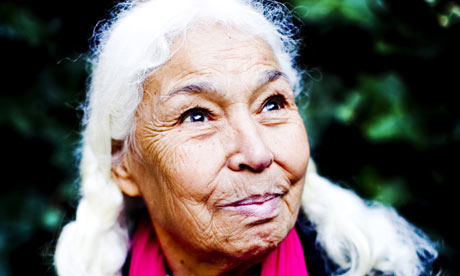
The Fall of the Imam is a novel by Nawal El-Saadawi, an Egyptian feminist writer and activist. I really hope this post makes you decide to read the book.

Nawal-El-Saadawi-001.jpg
From reading El-Saadawi's memoir about her time in women's prison, I was under the impression that she denounced religion. This assumption made me believe she was not a spiritual person. However, I was pleasantly surprised, when I found that The Fall of the Imam was entirely about spirituality and what it should be. Her story weaves in heavy criticism of organized religion as a tool of patriarchy. She exposes how these institutions fear any challenge that can empower the people and cause them to question. While depicting this, Nawal shows how children are born with a natural form of spirituality that recognizes "god" as both a mother and father.

Additionally, Nawal portrays the mother and the daughter are the heroic and revolutionary figures who fight against the male dominated society. By doing this with such a poetic and mystical style, Nawal taught me how to love women and see them as strong. I do not now why it took a book to do that for me, but the message was so strong throughout the entire novel that it had a huge impact in making me appreciate the relationships between women in their struggle against patriarchy.

fall-imam.jpg
The most powerful part of the novel is the structure. It is written in a cyclical style with a strong and tragic recurring image. While the image stays the same for the most part, the perspective and context changes throughout the novel. For me, the effect of this was that the image became related to a feeling--a feeling of love for the mother and life, how these two forms can be interconnected, and how this feeling can be deadly in a patriarchal society. It combines the beauty of life with the tragedy of repression. The image reminds me of pagan beliefs and an appreciation for "mother nature." The image is first described in the passage below:

She would have escaped had she not been halted by the smell of the land and the sea, bringing back her whole life in one moment. She halted, took a deep breath, and just at that moment the bullet struck her in the back and bored its way through like an arrow straight to her heart. She dropped to the ground, bleeding slowly. Her dog whimpered once and was silent, and the birds flew up in fright, filling the universe with their cries." 

What is interesting about the recurring theme in these passages is that Bint Allah ("daughter of God") never really "dies." She continues to have consciousness and relates memories to this one moment throughout the book. This also shows that "Bint Allah" can be seen as an idea for liberation that cannot be killed.

Victimization and Empowerment:

I also appreciate how Nawal shows women as strong, even when they are in situations where they are the victims. For example in the chapter titled "The Imam and Bint Allah," the Imam tries to devour Bint Allah. Since he cannot do this intellectually (she will neither give into his demands for respect nor follow his patriarchal religion), he tries to physically devour her. The context of this scene leads me to believe he is raping her; however, Nawal shows how Bint Allah has power over the Imam because he cannot devour or conquer the part of her that he fears--her ability to challenge male dominion, which makes the Imam fearful and insecure, and eventually destroys the Imam.

He sat in front of her sucking her bones, cracking them like sticks of sugar cane and extracting the marrow from the inside, with his tongue and lips. She watched him as she would watch a sheep fattened for the Big Feast enter the butcher's shop, his eyes sinking into their sockets with fear, for in his eyes there was nothing but fear, a terrible fear. No matter how much he ate he was never satisfied and no matter how much he protected himself with all sorts of things he never felt secure. She handed him bone after bone, then gave him the shoulder blade followed by the rump and the spleen. His belly was full, swollen like a goat skin, but she continued to hand him one piece after the other until she heard the sound of an explosion and his face fell to the ground. His eyes opened wide with surprise as though he could not believe what was happening and she said to him in a bantering tone: It begins as a game and ends in ruin. Then she lept away, light-footed as a doe, with her dog running close behind her. (144-145)

This suggests that women, as a force that challenges patriarchy, cannot be killed or suppressed, even though individuals might be. In the above passage, it is interesting how Bint Allah willfully gives the Imam her "bones" to suck on. I think this is perhaps because she knows that she can destroy him with her intellect. It is as if her body is a trap that she uses to lure him towards death. She recognizes the Imam's desire to devour her as "game," which she plays along with, knowing that it will end in ruin for the Imam. In this sense, the rape is allegorical for all relations between patriarchal men and women and should not be thought of as a literal scenario where Bint Allah willingly allows the Imam to rape her.

I think the above passage is an extremely interesting depiction of rape. It seems like most male authors always focus on the sexual aspects of rape, which objectifies the victim, even if they are still trying to gain sympathy for the female character. However, Nawal associates the act with a self-destructive gluttony that shows how patriarchy itself is self-destructive because its repression creates females who challenge it. I also think that the metaphor of the Imam sucking the marrow out of Bint Allah's bones depicts the emotional and physical pain better than realistic accounts might. This is because rape is more than a physical action and therefore can only be accurately described in ways that illustrate the violence in physical, emotional, and spiritual ways.

Definition of Love:

One of the most beautiful aspects of the book Bint Allah's recollection of falling in love, described in the chapters, "Ecstasy of Love" and "Together in the Trench." Below is a passage from "Ecstasy of Love":

During the day I moved from one wounded man to the other, carrying a pot for urine and another for stools. At night I kept wide-awake straining my ears to catch a moan. I could see his face as he turned it towards me in the dim light. It was thin and pale and wan. Over his chest there was a deep wound and from his eyes looked out a tender yearning. In the dark of night I go towards him and say: Fadl Allah was at the war front, did you see him there? Is he alive? Who is Fadl Allah? he asked. Is he your husband? He is my milk brother and he was with me in the orphanage, I said. Then I fell silent. Why are you silent? he said. What shall I say? Tell me about yourself, he said. But what can I tell you? Tell me everything, he said. 

But I did not know what to say. My life seemed full of secrets and yet when I started to talk it looked empty as though there was nothing in it to talk about. He surrounded me with his arms like a mother and whispered to me, Go to sleep, and as I slept all my fears slipped away from me. I began to talk about myself and each time I recounted something my tongue became freer and freer and my heart grew lighter and lighter. My body seemed to be flying like a body without weight. As I climbed higher and higher up the hill a gasp escaped my lips. I had always dreamt of going up to the top of the hill. For twenty long years, ever since I had been born, I had continued to see the hill between the river and the sea, there were my mother stood waiting for me. I could never forget the smell of the air, nor the damp earth under my palms, nor could I forget the tree and the rock and the slope of the hill rising up. Here was my land, my country. Its smells were the smell of my life, strong and penetrating. I opened my arms, filled my lungs with a deep breath of air like the first breath of life at the moment of birth, like the last breath of life at the moment of death. And for the first time since I was born I took in everything in one deep breath, the smell of the sea, of salt water, of iodine, of seaweed and molluscs and fresh fish. I abandoned myself to the sea air, let it seep into me, fill me up, drown me in its softness. Its white waves rose up in the night reaching to the sky, enfolding me like the arms of God. And he was by my side holding me in his arms and saying: 

Do you like fish grilled on charcoal?
I love it.
Do you prefer the head of the fish or its tail?
I like both of them.

His laughter rang out, filling the universe like the laughter of children, like an oyster shell opening its lips to desire. The air of the sea filled her with a lust for life, with a deep hunger hungry for everything. All her senses were suddenly awakened like waves in wonderful turmoil. The stars glittering over the sea were like lighted pearls. The rustle of leaves, the sound of the waves, the whisper of the wind, joined in a single call going deep. Her black eyes opened wide in abandonment to the ecstasy of love, to the moment when everything else is excluded. Then when it is over, she closes her eyes and sleeps on his chest like a child being rocked slowly, and his voice wafted to her from a distance whispers: I love you. (83-84)


I think this passage captures the comfort of finding someone to listen to your story. In a society where most people do not care about one another, it is empowering to find someone who is curious and cares. Additionally, in a patriarchal society, where women and their stories are often silenced, he provides Bint Allah the opportunity to express herself.

Here is another beautiful passage from "Together in the Trench," a poetic chapter where Bint Allah reunites with her childhood friend Fadl Allah in a trench during a war:

She closed her eyes and said: I see you as though it was only yesterday when you left. I see you as you are, as you always have been. You have never been absent, you have always been with me. He closed his eyes and rested his head on her breast just as he used to do when still a child, then suddenly awakening opened his eyes and looked at her, seeing her as she was now, a woman. They were still in the trench and time had stopped moving. He put his arms around her, and the trench became too narrow for the two of them, too narrow for his arms stretching out to enfold her, too narrow for the vast universe, as vast as the burning disc of the sun up in the heavens. And she too wound her arms around him and the trench was now too narrow for her, for her to hold the universe in her embrace. And when light revealed them in the trench holding each other, they did not unwind their arms or move apart but held each other in a long embrace, their bodies slowly merging into one and the whole world stood still to watch a scene of love, to see two beings changing into one, never to part again, never afraid of the light, never afraid of death, for each of them had known what dying was. Now he and she were gone, lost in one another, dissolved. Now no force in the world could make them part again, neither the noise of guns and rockets all around nor the loud abuse of enemies or the whispers of their friends, nor the orders of the Imam or the Devil or the Chief of Security himself. 

I opened my eyes and found myself standing in the trench alone with the letter folded in my hand. Where was Fadl Allah? I wondered. Where had he disappeared to? Had he died in the war? Had he died in prison? In the distance I could hear their panting breath draw nearer, their feet treading on the ground with the sound of their iron-heeled shoes. So I started to run in the dark of night, trying to save my life. They kept coming after me, their dogs yapping and barking behind them, and I kept on running, now knowing why I was running like this all the time. I had got as far as the spot where the hill begins to rise. It was just before the break of day and I was on the verge of giving them the slip when one of them took aim at me and got me in the back. My body continued to run a few steps, then fell to the ground, but before the letters of the alphabet had disappeared from my mind I said: He was my brother and he was with me in the children's home. Your sins are without end and shall be counted against you, in this world and in the world to come, I heard them say. You are a child of sin and so is he, and his name is not written either on the lists of Hizb Allah or on those of Hizb al-Shaitan. 

I was running and the night was black as ever. I could hear them tread with their iron feet as they chased after me. I touched my belly with my hand, feeling for it in the night as I ran. It was round and smooth and loving, warm under my palm. His voice reached me, calling from a distance, sounding like the voice of my mother: Bint Allah, come here. He moved nearer to me until our bodies almost touched. I wound my arms around him and we locked in a tight embrace. A shiver like a strange fever went right through me deep inside. A voice whispered softly in the night: Fear not, I am God and you shall give birth to Christ. It was dark and I was still running with the letter held tightly in my hand. I hid it in my bosom when I heard them panting close behind. I delivered his letter to her. I will risk my life to save it. It is more precious to me than the most precious thing I have. I will risk being stoned to death, like the Virgin Mary who risked her life to give birth to her son, like my mother who died to bring me to the world. When I reached the place where the hill starts to rise upwards midway between the river and the sea, the smell of the earth came back to me. Suddenly I felt safe and just at the moment when I could have escaped I stopped to thank God for saving me. As I knelt in prayer they hit me in the back. They always strike me from behind and when I turn around to face them they quickly disappeared. They never look me in the face. Before I fell to the ground wounded in the back I said to myself. My belly was full of the fruit of love when I kneeled on the ground to pray, but I hear the Chief of Security say: Love does not exist, only the fruit of sin. (88-90)

The above passage illustrates how true love is forbidden in the patriarchal society. While it is overtly forbidden in the society Nawal illustrates, it is also forbidden in any patriarchal society because of the gender binary. Lovers have to challenge this binary in order to find true love and doing so breaks the rules of patriarchy.

"Racism in the name of Feminism" or "Ideological Rant about Frustrations with Myself and the Left"

Article:

http://theaerogram.com/no-means-no-femens-assault-on-muslim-women/#comments

It seems to me like FEMEN's actions operate under the assumption that there is one way for a woman to liberate herself--by flinging off all of her clothes. Traditional clothing vs. modern clothing vs. nudity are lifestyles that can either be oppressing or liberating. Each society has its own code imbedded in it where, if broken, people become alarmed. Traditional clothing can be oppressive if it is forced on someone who would prefer individual expression; or it can be liberating in that it symbolizes a rejection of Western culture. Similarly, nudity can be oppressive when it is used to objective women in the media; or it can be liberating to display the body as it is without covering. This all depends on the individual and the context of the situation. 

It is because of this that FEMEN should not look at nudity as a definite means for liberation; and should not look at traditional Muslim clothing as a definite means for oppression. 

"Defiant exposure of the body may very well be how some women feel empowered, but it is ignorant to presume that this is true of all women. This is especially true of female Muslims, who can be shamed by both outsiders and fellow Muslims because of the way they chose to dress."

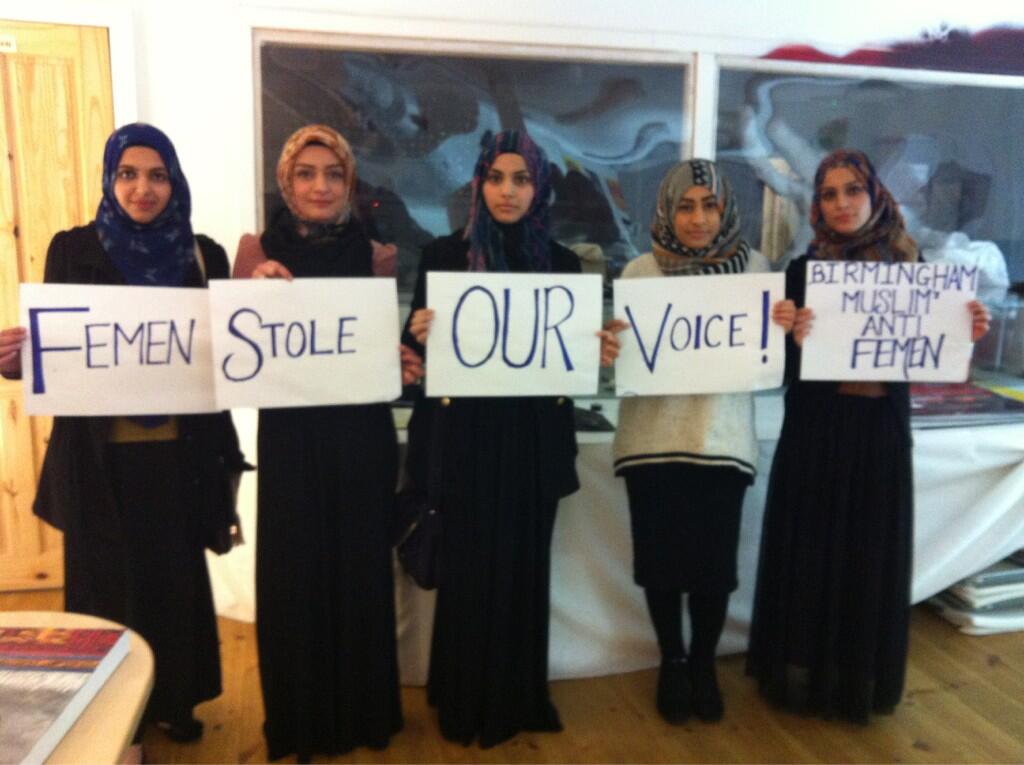
I learned in my Muslim Women Writers class that it is not the religion itself that is oppressive to women, but the patriarchal interpretations of religion. There are feminist interpretations of Islam that can be quite empowering. It is the patriarchal interpretations which are fueled by the political institutions, that need to be targeted, NOT the religion itself. 
mw.voice_.fb_.jpg

"Little surprise then that Muslim women are distrustful of other (usually white) women who try to “liberate” them. In fighting for the liberation of Muslim women, non-Muslim women rarely engage Muslim women in a way that allows Muslim women to keep their own agency. Instead, non-Muslim women try to “liberate” Muslim women through control — imposing Western perspectives and in essence, causing Muslim women to become invisible in their own battle."

FEMEN's actions targeting the Muslim religion are racist because they take away the agency of the Muslim women. Additionally, they target the religion in isolation from the patriarchal political institutions, which they should be criticizing. Rather than asking Muslim women how they want to liberate themselves, FEMEN forces their own interpretation of liberation on them. Additionally, it should be noted that all Muslim women should not be lumped into one category--religion is one small sliver of their identity. Subscribing one method of liberation for such a broad group of people is not productive. Perhaps FEMEN should look at a more unifying category such as class and find ways to liberate women within a particular class. Issues such as unpaid work are much more pressing than issues related to fashion. 
_____________________________

From my own experiences, I know what it is like to have someone (in this case, it was a male) try to force me toward "liberation" through persuasion. By giving into his definition of liberation, I was actually allowing myself to be oppressed by his impositions. At the time, I thought I was being liberated; however, looking back, I can see that it was something I did not want. Rather, it was something that he thought would liberate me. Without getting into the specifics, I hope you can understand what I am talking about. 

How does this fit in with the larger struggle? First of all, a lot of these forms of liberation deal with an individual's lifestyle. While they can be empowering to some individuals, others might not be ready or might not see them as empowering. These lifestyle liberations are not what particularly matters to the movement. Individuals can liberate themselves in a variety of ways that can empower themselves within a movement--and they should be able to choose which way fits them best. Otherwise they are not empowered. People should not judge one another on their lifestyle decisions unless they negatively affect another person. 

Concepts of liberation should instead be based on a broader analysis of oppression and how it is manifested in different forms for different groups of people. What matters is the ideological analysis that people have on collective oppression. FEMEN probably thinks it has an ideological analysis of how Islam oppresses groups of women. But they address this analysis in the wrong way--by calling on individuals to denounce their religion instead of targeting and addressing the political institutions as a whole. 

But even then, wouldn't that alnalysis still be imposing its Western view of what is "liberation" onto the collective? I believe this is different. What organizations should be doing is supporting the option that gives the oppressed the agency to recognize the cause of their oppression and to liberate themselves. However, this is easier said than done. Sometimes these "options" are not even available.
fantasia-algerian-cavalcade-assia-djebar-paperback-cover-art.jpg

For example, I just finished reading Fantasia: An Algerian Cavalcade by Djebar. In this novel, she poetically illustrates how the French's colonization of Algeria had some positive aspects for some women. For example, some women, even from lower classes, learned how to read and write in French, which allowed them to challenge their patriarchal institutions to a certain extent. However, overall, the French occupation had a negative effect on Algerian society. Then there was the revolution. Now, had I been alive during the time, I would have definitely supported the nationalist movement (while still being critical of the groups that were likely to come to power after). However, when the nationalist movement won, there was a return a political institution that practiced a traditional patriarchal form of Islam, and the promises that were given to women were taken away. 

In this example, there is not really a clear option that would give the oppressed the agency to recognize the cause of their oppression and liberate themselves. Their analysis of their oppression ended with the French and did not include capitalism. So what I would think is right is the following: support the nationalists because they are clearly against the oppression of the French. Once the nationalists have gained liberation, be critical of the new regime and support a new revolutionary group that will continue on the trajectory toward liberation. 

I am only starting to realize how complicated these issues are when applied to the real world! No wonder the left is so scattered and scared to take stances on anything. Studying Marxist theory makes it seem so simple, but the world has divided itself into multiple classes all pitted against one another, while allowing the ruling class to continue domination! It seems so difficult to untangle this mess, but people must be patient. It seems like it is so easy to take the "wrong" stance on issues when there are so many options. In the long run, we need to unite somehow, and we should all appreciate one another for at least trying to make the world a better place. Our criticism should exist without hate, and we should reserve the hatred for those actually in power. 

Yet this is so difficult when I have the strong conviction that certain groups on the left are actually helping the ruling class by reinforcing some of their institutions... 

I don't know! I am even more confused than I was before I started writing. 


Monday, March 11, 2013

Scheherazade Goes West by Fatema Mernissi


For my Muslim Women Writers course, I had to read Scheherazade Goes West by Fatema Mernissi. I thought the book was interesting and definitely worth reading. It is about the author Fatema Mernissi's quest to understand the varying perceptions about harems--women's prisons--in the East and the West. In this book, Mernissi makes an interesting argument about Muslim feminists by emphasizing the strong female historical and traditional characters.

Mernissi argues that in both cultures, patriarchy is manifested in two different ways. In the Muslim world, women are more spatially repressed by veils and where they are allowed to physically go. However, according to Mernissi, the culture does not pretend that women do not have intellectual capacities. Rather, higher percentages of women are in high ranking science and business positions than in the Western world. Additionally, female characters in Muslim folk tales and in their history are depicted as strong; and women in harems were often expected to entertain men with intellectual and artistic skill. This means that these skills were important to the science of attraction in the Muslim world.  One example Mernissi gives is the character, Scheherazade, in One Thousand and One Nights. Scheherazade is a female character who cleverly tricks a cruel tyrant into allowing her to live--after he repeatedly killed his lover. She tells him stories that require psychological and intellectual skills, as well as the ability to control her fear of losing her life (47-48). Scheherazade not only convinces the king to fall in love with her and allow her to live, but she also helps solve the kind's sociopathic psychological problems and guides his decisions to be a more humane ruler.

Conversely, the West controls women in a more subliminal fashion--by controlling their physical appearance through definitions of beauty that are defined by men, and by stripping intellect from the list of characteristics that are deemed "attractive." The western form of patriarchy reduces the definition of the desirable woman to a mere body, without intellectual capacity. While western women are allowed to be more mobile society--they are free to attend school, participate in most social events, and are technically allowed into all positions of work (although few women achieve these positions). Mernissi illustrates this by observing how the Western versions of the Scheherazade story strip her of her intellectual power and reduce her to a beautiful creature who enchants the king (68). However, Mernissi argues that, if this was the case, the king would have killed her just like all of the other women. Additionally, the Western form of patriarchy pressures women to conform to an appearance that is unnatural for women--they expect women to remain skinny like children. This is symbolic of how western men also expect women to have the intellect of a child so they can patronize them. Ironically, women who try to be skinny often suffer from malnutrition, which makes them more passive, emotional, weak, and unable to think clearly (218). Coincidence?

I believe this book definitely makes an important argument about Eastern vs. Western culture. Thanks to the mass media, Westerners commonly believe that Muslim women (in general--yet Muslim women are just as varied as Christian women) are extremely oppressed simply because they wear a veil. However, Mernissi shows that many Muslim women are actually empowered by the belief that their intelligence matters. Additionally, they do not have to fulfill the same beauty expectations that women in the West have to fulfill.

Scheherazade Goes West confirms my suspicion that, in some ways (excluding extreme circumstances where women are killed or seriously abused), the subliminal oppression of women in the West is worse. This is because many women in the West do not recognize the extent to which they are oppressed, objectified, and stripped of their intellect; or the extent to which men are encouraged to force themselves on women and view them as mere bodies. This prevents them from taking any action to challenge or overcome this patriarchy.

I do have some criticisms of the book. For example, Mernissi spends all of her time studying the manifestation of patriarchy in Western and Eastern bourgeois culture. While, in many cases, the ruling class defines how men should treat women, I do not think this could even hint at the conditions of the poorer classes in Muslim societies and Western societies. Mernissi also ignores the political realities of many Muslim countries that interpret the Koran in ways that oppress women. I think these realities are much more important than abstract manifestations of women in stories. However, the information in Mernissi's writing is potentially empowering for women.

This book has inspired me to study feminism more. In the past, studying issues that western women face has frustrated me beyond the ability to further pursue research. However, now I can see how taking tid-bits from each culture can empower me and show me that different visions of attraction exist and therefore I do not have to conform to any particular vision of attraction.