Showing posts with label the left. Show all posts

Sunday, April 28, 2013

Conclusions About Tent State University

My previous post about Tent State opened up some conversations that clarified my feelings about the event. First of all, I no longer suspect that what we did can be considered as "wrong." Doing anything on campus to get students thinking is extremely important because it is necessary to disrupt students' complacency and make them question. We were very effective in doing this. Secondly, it is important to note that the strongest reactions were from the people who were already political and who were perhaps dogmatic about their beliefs. This is a very small population of the actual students, and therefore we should not worry about them or waste our time arguing with them. If some of them want to have a civil conversation, that is fine; but overall they are a distraction from the real audience. The regular students did not strongly reject what Tent State was presenting, and many were curious and open to conversation.

Moving forward, I hope that SDS can find a way to address both international struggles and issues that students can relate to, while making the connection between the two. My previous experience with SDS can confirm the necessity for working for both audiences to appeal to a wide variety of students. For example, at the prolonged times where SDS was engaged in student issues, many people who were more interested in international issues stopped being involved; now that our focus has shifted to international issues the opposite has occurred. One practical way we can do overcome this obstacle is by having two campaigns.

Regardless of the direction SDS takes, I hope the leadership avoids becoming distracted by the critical minority of students. Many students seem to think it is adequate to criticize those who take action, while abstaining from actually doing anything on campus. A more productive response from those who are critical would be to design their own actions and campaigns--then we will be more successful in achieving our goal for a more active campus. 

Saturday, April 20, 2013

"Racism in the name of Feminism" or "Ideological Rant about Frustrations with Myself and the Left"

Article:

http://theaerogram.com/no-means-no-femens-assault-on-muslim-women/#comments

It seems to me like FEMEN's actions operate under the assumption that there is one way for a woman to liberate herself--by flinging off all of her clothes. Traditional clothing vs. modern clothing vs. nudity are lifestyles that can either be oppressing or liberating. Each society has its own code imbedded in it where, if broken, people become alarmed. Traditional clothing can be oppressive if it is forced on someone who would prefer individual expression; or it can be liberating in that it symbolizes a rejection of Western culture. Similarly, nudity can be oppressive when it is used to objective women in the media; or it can be liberating to display the body as it is without covering. This all depends on the individual and the context of the situation. 

It is because of this that FEMEN should not look at nudity as a definite means for liberation; and should not look at traditional Muslim clothing as a definite means for oppression. 

"Defiant exposure of the body may very well be how some women feel empowered, but it is ignorant to presume that this is true of all women. This is especially true of female Muslims, who can be shamed by both outsiders and fellow Muslims because of the way they chose to dress."

I learned in my Muslim Women Writers class that it is not the religion itself that is oppressive to women, but the patriarchal interpretations of religion. There are feminist interpretations of Islam that can be quite empowering. It is the patriarchal interpretations which are fueled by the political institutions, that need to be targeted, NOT the religion itself. 
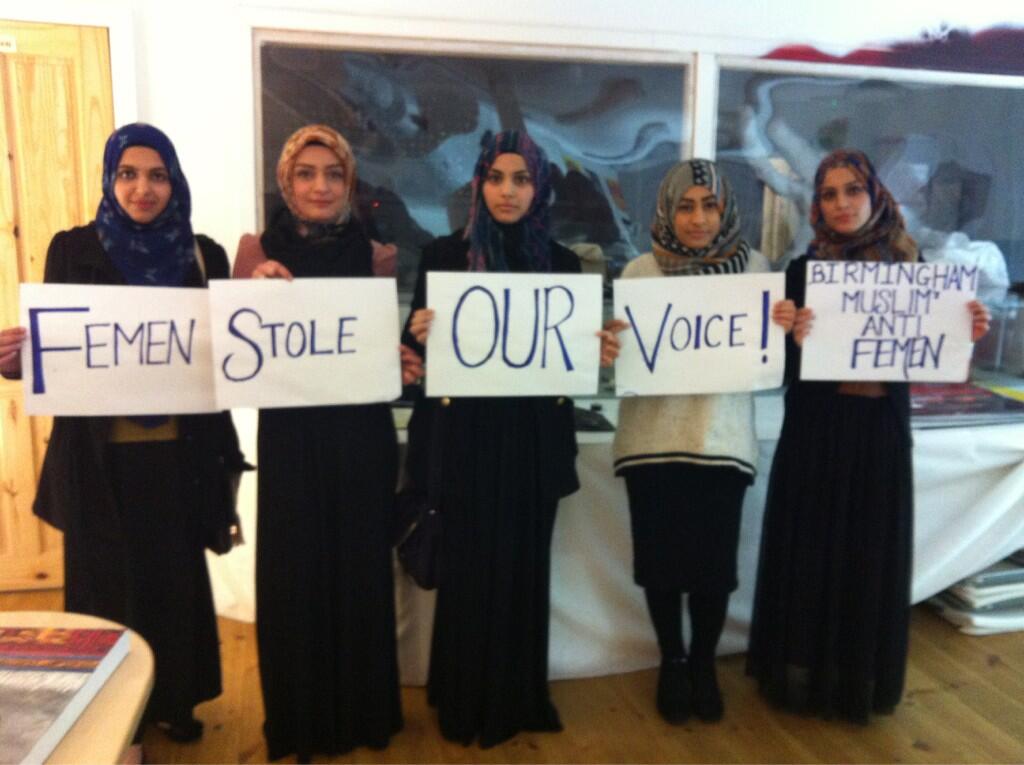
mw.voice_.fb_.jpg

"Little surprise then that Muslim women are distrustful of other (usually white) women who try to “liberate” them. In fighting for the liberation of Muslim women, non-Muslim women rarely engage Muslim women in a way that allows Muslim women to keep their own agency. Instead, non-Muslim women try to “liberate” Muslim women through control — imposing Western perspectives and in essence, causing Muslim women to become invisible in their own battle."

FEMEN's actions targeting the Muslim religion are racist because they take away the agency of the Muslim women. Additionally, they target the religion in isolation from the patriarchal political institutions, which they should be criticizing. Rather than asking Muslim women how they want to liberate themselves, FEMEN forces their own interpretation of liberation on them. Additionally, it should be noted that all Muslim women should not be lumped into one category--religion is one small sliver of their identity. Subscribing one method of liberation for such a broad group of people is not productive. Perhaps FEMEN should look at a more unifying category such as class and find ways to liberate women within a particular class. Issues such as unpaid work are much more pressing than issues related to fashion. 
_____________________________

From my own experiences, I know what it is like to have someone (in this case, it was a male) try to force me toward "liberation" through persuasion. By giving into his definition of liberation, I was actually allowing myself to be oppressed by his impositions. At the time, I thought I was being liberated; however, looking back, I can see that it was something I did not want. Rather, it was something that he thought would liberate me. Without getting into the specifics, I hope you can understand what I am talking about. 

How does this fit in with the larger struggle? First of all, a lot of these forms of liberation deal with an individual's lifestyle. While they can be empowering to some individuals, others might not be ready or might not see them as empowering. These lifestyle liberations are not what particularly matters to the movement. Individuals can liberate themselves in a variety of ways that can empower themselves within a movement--and they should be able to choose which way fits them best. Otherwise they are not empowered. People should not judge one another on their lifestyle decisions unless they negatively affect another person. 

Concepts of liberation should instead be based on a broader analysis of oppression and how it is manifested in different forms for different groups of people. What matters is the ideological analysis that people have on collective oppression. FEMEN probably thinks it has an ideological analysis of how Islam oppresses groups of women. But they address this analysis in the wrong way--by calling on individuals to denounce their religion instead of targeting and addressing the political institutions as a whole. 

But even then, wouldn't that alnalysis still be imposing its Western view of what is "liberation" onto the collective? I believe this is different. What organizations should be doing is supporting the option that gives the oppressed the agency to recognize the cause of their oppression and to liberate themselves. However, this is easier said than done. Sometimes these "options" are not even available.
fantasia-algerian-cavalcade-assia-djebar-paperback-cover-art.jpg

For example, I just finished reading Fantasia: An Algerian Cavalcade by Djebar. In this novel, she poetically illustrates how the French's colonization of Algeria had some positive aspects for some women. For example, some women, even from lower classes, learned how to read and write in French, which allowed them to challenge their patriarchal institutions to a certain extent. However, overall, the French occupation had a negative effect on Algerian society. Then there was the revolution. Now, had I been alive during the time, I would have definitely supported the nationalist movement (while still being critical of the groups that were likely to come to power after). However, when the nationalist movement won, there was a return a political institution that practiced a traditional patriarchal form of Islam, and the promises that were given to women were taken away. 

In this example, there is not really a clear option that would give the oppressed the agency to recognize the cause of their oppression and liberate themselves. Their analysis of their oppression ended with the French and did not include capitalism. So what I would think is right is the following: support the nationalists because they are clearly against the oppression of the French. Once the nationalists have gained liberation, be critical of the new regime and support a new revolutionary group that will continue on the trajectory toward liberation. 

I am only starting to realize how complicated these issues are when applied to the real world! No wonder the left is so scattered and scared to take stances on anything. Studying Marxist theory makes it seem so simple, but the world has divided itself into multiple classes all pitted against one another, while allowing the ruling class to continue domination! It seems so difficult to untangle this mess, but people must be patient. It seems like it is so easy to take the "wrong" stance on issues when there are so many options. In the long run, we need to unite somehow, and we should all appreciate one another for at least trying to make the world a better place. Our criticism should exist without hate, and we should reserve the hatred for those actually in power. 

Yet this is so difficult when I have the strong conviction that certain groups on the left are actually helping the ruling class by reinforcing some of their institutions... 

I don't know! I am even more confused than I was before I started writing.