Showing posts with label capitalism. Show all posts

Friday, May 3, 2013

Yoga Class Reflection


Below is a reflection paper I wrote for my yoga class. Overall it was a great class and helped me in many ways. I challenged the professor on several ideas he taught. For example, he argues that we should drink bottled water because tap water has fluoride in it. Also, he takes a individualistic approach to solving the problems in the world. While him and I may agree on the "ends," I believe his solution is not enough for achieving these goals. 


The yoga class helped strengthen different parts of me mentally, spiritually, and physically. Before taking the class, I had experience doing yoga in other places; however, I was never able to move past my desire to compete with myself and others to be the “strongest.” I think this was because the classes were not paired with instruction about the spirituality behind yoga.
            I thought it was useful how each week focused on a different chakra. It is interesting how I gained something from each class; it seemed like each lesson applied directly to something that was happening in my life. For example, with the first chakra, I was having trouble paying for food and did not have a good living situation; but was prioritizing other “needs” above this such as worrying about grad school applications. I was getting sick way more often than I used to. After the class, I realized that I was not taking care of myself and it was affecting my ability to focus and relax. The music helped with this as well. The second chakra taught me to reflect on my current and past relationships and come to peace with the engagement that I broke off several months ago. Also at the time of this class, I was dealing with some conflicts with “toxic” people and the class taught me to let go of them. The list goes on. Now, I have a new interest in studying the different chakras and using them to improve my health and interactions with others.
            I appreciated how the actual yoga we did was not very advanced compared to the other classes I took. This showed me that yoga is not about pushing myself to do advanced moves, but I should instead work on a gradual progress. Although the moves were not “advanced,” I found my muscles feeling sore after almost every class. This shows that the basic moves and poses are important if done properly.
            The lesson about food was interesting. I have a holistic healer in my hometown who has done similar things with my arm for the vitamins and medicine I was taking. He took me off all of these supplements and gave me herbal supplements and suggestions for diet. So coming into the lesson, I was already familiar with the process, but did not realize it could be applied to people and drinks. I went home and tried it with some friends. I have some disagreements with the argument about tap water. Water should be free for everyone and should not be a commodity. Additionally, private companies have less regulation for the chemicals and processes used in the water. Some bottled water is actually tap water too. Leaving tap water in an open container for several hours allows the most of the chlorine to evaporate. I am not sure if this includes the fluoride. I heard that the government puts fluoride in the water because lower income people do not have as much access to it. I do not necessarily agree with this argument, but prefer fluoride water to supporting companies that have tricked the population into buying a basic life necessity and creating tons of plastic waste from the bottles. Bottled water should not be thought of as a solution to having fluoride in tap water.
            As far as the philosophy presented in the class—I agree with most of it, but I think more is necessary. The world cannot wait for every individual to “convert” to be a better person. We are all shaped by our culture and are given prejudices that can be harmful. I think we need to change the institutions that shape our culture such as the education system, legal system, “democratic” process, economic system, etc. We need to redistribute the wealth and get rid of the idea that the US should control all other countries for economic profit. 

Saturday, April 20, 2013

Reflections on "Tent State University"

tent-state-e1366210562772.jpg
I have heard talk about people's frustrations with this year's Tent State. I have thought of three different ways of mentally processing these frustrations, all with different implications. I am going to try to analyze these thoughts, while being as honest to myself as possible because I can probably learn something from this experience:

1) There were only a handful of people willing to organize this year's Tent State. These people organized it how they saw fit. If other people want to criticize this year's Tent State, then that is fine, but they should accept how they were not willing to help or do their own. Additionally, this was the only action taken all semester. Those who are criticizing should be putting their criticism to good use by organizing actions in ways in which they see fit. Similarly, I have heard the argument that this is not how "Tent State University" is supposed to be, and I find myself asking, "Who is the decider of what Tent State is supposed to be?" Why can't it manifest itself in different forms of different campuses based on the activist groups which are present and willing to contribute? As far as I am aware, I do not believe there is not any copyright on the idea of "Tent State," and even if there was it seems oppressive to enforce standards on a model for educating and raising awareness. 

The implications of looking at the criticisms allow me to justify our actions, while still considering their criticisms. I do not have to go insane at the thought of having done something wrong.

2) My next way of mentally processing Tent State is a worry that lingers over my mind like a dark cloud. What if we were wrong? Maybe we are a bunch of phony radicals who tricked ourselves into thinking that waving red flags will magically lead us toward communism? Are we just fooling ourselves? What if we were being elitist against the other leftists organizing on campuses? With these questions come anxieties and worries: What if they hate us? What if we are doing more harm than good? Then I get depressed and think about how it is not satisfying to simply be campaigning for lower tuition. I cannot morally justify doing this while I now that it is tied in with such larger and more pressing issues. I cannot care more about the college population that I do about the people dying as a result of US imperialism. Similarly, I cannot take groups seriously that fail to make these connections and that seemingly (through their inaction and direct or indirect support of Obama) contribute to much of the oppression that occurs on a larger scale. I have heard about working within these groups with these goals to recruit a broader range of students and having them be radicalized through experience, but I feel so alone in fighting for this and find myself lacking patience. Have I fallen into some sort of self-destructive ideological trap? I am afraid and want to crawl into a cave and hide from these attacks. 

3) My third way of handling it is more of an internal struggle. As one person, who am I to voice support for the nations that have challenged US imperialism? Have I turned into an ideologue who is no longer able to relate to the proletariat because of the consciousness that I have gained? I feel so alienated--from the beliefs of my family and old friends AND from the beliefs of comrades who I used to work with on the left. I no longer gain satisfaction from listening to leftist speakers--I just find myself criticizing them for not doing enough and angry with them for settling with small reforms. I think this ties in with the reform vs revolutionary action debate that I have not yet completely solved. While I know that certain reforms can serve to empower groups of people, I also feel like they mislead leftists into believing that all problems can be solved through reform. This allows many lefts to feed into the very system that oppresses them. One example is activism around school reform. While I admire how they can work toward improving public schools, I find myself being fatalistic about the ultimate fate of public schools. I find myself believing that any positive reforms gained can easily be undone. I see all of the energy going into changing the smallest aspects of the school system by navigating the capitalist bureaucracy--and I can't help but feel like a large part of it is wasted. Who are we--small ants--to beg the system for crumbs of reform when other ants are being stepped on all over the world? And yet, what else is there to do when that is what the majority of the people on the left are doing? By straying from this model am I being a mere individualist? 

POSITIVES:
1) The conversations we were able to have with people about how tuition ties in with the larger issues of imperialism and capitalism. 
2) Many people who were never exposed to the positive aspects of communism were able to talk about it and rethink their thoughts on it
3) People across campus were talking about tent state and asking questions about if we were being too extreme. We provoked many people.

NEGATIVES:
1) We alienated potential allies that we could have had during the occupation.
2) It is possible that, for some people, the message about lower tuition was lost in the ideology that we were expressing. 
3) We did not communicate transparently with the volunteers who joined us about how to handle the cops and when we were planning on cleaning up.
4) We did not fit Tent State into an ongoing campaign that carried through the semester. This ongoing campaign did not occur due to internal issues.

I honestly do think that the positives balanced with the negatives. If we did Tent State in a different way (given the resources we had) that was more focussed on tuition, I believe the positives and negatives would have balanced out in a similar way. For example, more people would have responded to the issue relating to tuition, but we would not have raised as much awareness about how education funding connects with broader issues of capitalism and imperialism. 

This raises important questions about tactics. Is it better to dilute the message to appeal to a broader range of people, or to have a strong and defined message that provokes people into questioning their own ideology? I think it is important to have a little bit of both, when possible. I do not think having Tent State the way we did means we can no longer engage in campaigns that are purely against tuition. Perhaps we can solve the problem by opening up conversations within the organization about balance. 
_____________

I hope I have been humble with my thoughts. This is as honest of a picture as I can make of the thoughts in my head.

______________

Below is a comment I received from someone through email that I thought was worth sharing:

I think there is a lot of complexity to the situation. Thanks for writing so much of your thoughts, Lisa. I would like to find a way to make this event even better for next year. I think that overall the event was pretty good. It got people talking and was something concrete that we were able to work on together and pull off successfully. After a semester of only doing water issues stuff it was nice to discuss other issues.

Because of the split at the beginning of the semester, there as not as big or broad of a group willing to put things together. I only got involved the day things started. So this definitely was reflected in what issues were the focus of the event. I think that if more people had been involved in the planning that the focus would have had to be on common ground issues such as tuition. But this year there was so much tension between people, I don't think anyone had much of a real taste for cooperation. For next year we can reach out to more people to get many groups to co sponsor the event. It involves camping out in the springtime and chatting on the grass, so it shouldn't be hard to attract people if we do it right.

I dont think the use of the name Tent State University is a too big of an issue but I think it is poor taste. There are no shootings or violence involved in our event and I think it is not good to have an event name that recalls Kent State. I've been told this is an NJUS name and I want to know how they thought this could be a good name for an event. For next year I would like a name that doesn't focus on such a negative event in history and instead has a more unifying and community-building feel to it.

I think that it is more important right now to focus on what unites us instead of on the issues that separate us. Montclair doesn't have a big activist community so we need to focus on building one here. This year's focus on radical issues such as the North Korea stuff pushed away people who otherwise could have been drawn in. The grad students in my office are fairly liberal and many are in a very tough situation because of rising tuition and significantly decreased school funding for the teaching and research jobs that let us work for our professors instead of working at Walmart. If this event had a different focus I imagine many of them could have been convinced to camp out because they basically sleep at the school anyway. But instead, they were laughing about the crazy NK stuff they saw in the quad and not discussing issues that could have gotten them actually involved.

Change happens very slowly sometimes. Women got the right to vote in 1920 but my grandma still had to get permission from my grandpa to get a credit card in the 1950s. We are all very small and we live in a huge world, so sometimes it feels like the little changes we can accomplish don't matter at all and that we need to find a way to make a big impact. But then I try so hard and still see that I am just one person and society all around me is so sick and apathetic that even my hardest effort rounds down to 0. I get really frustrated and sad and want to give up, but I was talking to a close friend who is much older than me and she was telling me about all the changes she has seen in her life and how over time it does all add up to something. So now I am trying to moderate my efforts so I don't get burnt out like I have felt so often before. I try to pick issues that give me joy to work on and not constant frustration. There is of course a big goal to see people finally find a way to live together peacefully and with love, but who knows if I will see it in my life time? So I need to still pay attention to creating as much positive change as I can see in my own lifetime, so that it will inspire me and make the world that I do live in now better now. 

I think that developing a larger and more active group on campus is very possible. Working aggressively toward that goal together would serve many purposes. We would be able to make concrete changes now on issues like lower tuition. Maybe tuition is a stupid idea in the first place, but even just accomplishing the short-term goal of no hikes next year works towards a more long-term goal of educational equality because it prevents an increase that would restrict access. These little successes can develop into big successes by changing our culture over time. We will also improve our own lives by being able to enjoy the company of a strong community. Maybe we will never see capitalism go down in our lives. Maybe we will get hit by an asteroid and all of this will have been pointless anyway. I would much prefer to have good friends that I can have good discussions (and disagreements!) with and work together on the things we agree on than to have divisiveness.

My response:
Thanks for the response. I hope you don't mind that I posted it on my blog for others to see. 

I agree with most of what you are saying. When I originally started SDS, I wanted to work on unifying issues and achieve small goals, while still trying to work to end capitalism. I think I became disillusioned with this process as a result of frustrations with NJUS and the voter reg drive, and am still facing that disillusionment. This is weird because, in case anyone remembers, I used to be one of the most positive and optimistic members in SDS.

This does not mean that I think doing the above would be a bad or good thing. I am still undecided. So basically, I need to sort out these personal issues and confusions. Thea, this does not mean I am questioning whether or not I am a communist (of course I am!)--I just think it is always good for me to question my tactics. Also--I feel really bad when my ideas for tactics, that I am actually sometimes unsure or insecure about, are applied to SDS and then face criticism. I feel guilty and wonder if the organization would be better off without me until i sort  out my confusion. But at the same time, it is hard to not be involved. Luckily, I won't be around SDS any more pretty soon and I will have time to start fresh with other organizations and to study these issues in more depth. 

Regardless of how I feel, I am going to try to come up with an objective summary of what SDS should be like: 

1) I think SDS needs to find a balance between student issues and outside issues. Historically, SDS is a student group that is against war and tries to tie in education issues with a broader critique of our undemocratic government and capitalism. I think in the future, SDS should be careful to try to include anyone who is sympathetic to any these issues, while making it clear that SDS is neither just a student union nor a communist group. We need to try to include all sorts of people on the left, as long as they understand the need for balance between issues. 

2) I think what happened with the split was that certain students were under the impression that SDS could serve as a student union and therefore should not mix in other issues that could alienate students sympathetic to tuition issues. However, this strays from the mission of SDS. Then, as a result of the split, those of us who remained in SDS strayed from the student issues aspect of the mission because of the tensions and not wanting to work with the people we split from. 

3) To prevent these conflicts in the future, we need to make it clear what SDS is and recruit people accordingly. We can also make it clear that people can participate in some of the actions that apply to their interests and do not have to participate in other sorts of actions. I know that I used to pretend we focussed mostly on student issues to try to "win" over new recruits. I think this was misleading and is not something that we should do. I don't think this necessarily means we need more structure in SDS. I think it has to do with how we market ourselves to the student population and how we present ourselves to new recruits. 

Regardless about how I feel about those tactics, that is as accurate of a portrayal as I can make of what SDS should be from now on. Those of us who are disillusioned, mostly myself, should use this image to get ourselves back on track. 

Does this mean tent state was wrong? NO! Like I said, there needs to be a balance between student issues and international issues. There were good things and there were bad things about Tent State. Tent State heavily emphasized international issues, so maybe the next thing we do can be about student issues. Also maybe for future tent states, we could try to have tuition and international issues more equally balanced. And there are always things we could do to make the connection between the two more clear. 

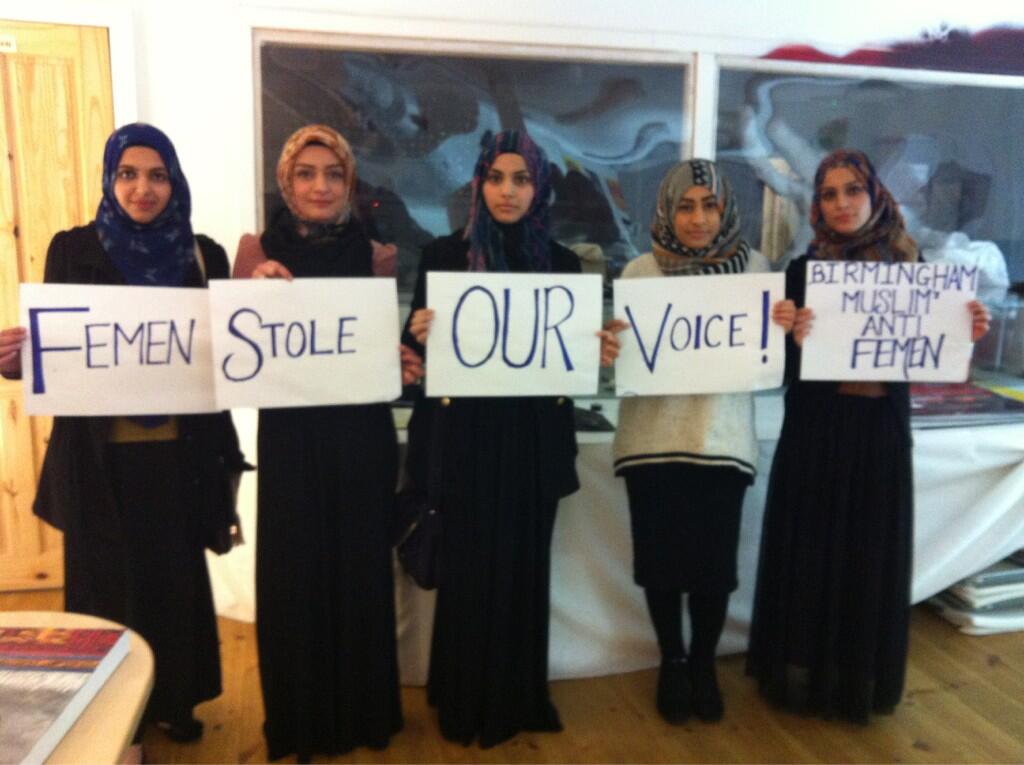
"Racism in the name of Feminism" or "Ideological Rant about Frustrations with Myself and the Left"

Article:

http://theaerogram.com/no-means-no-femens-assault-on-muslim-women/#comments

It seems to me like FEMEN's actions operate under the assumption that there is one way for a woman to liberate herself--by flinging off all of her clothes. Traditional clothing vs. modern clothing vs. nudity are lifestyles that can either be oppressing or liberating. Each society has its own code imbedded in it where, if broken, people become alarmed. Traditional clothing can be oppressive if it is forced on someone who would prefer individual expression; or it can be liberating in that it symbolizes a rejection of Western culture. Similarly, nudity can be oppressive when it is used to objective women in the media; or it can be liberating to display the body as it is without covering. This all depends on the individual and the context of the situation. 

It is because of this that FEMEN should not look at nudity as a definite means for liberation; and should not look at traditional Muslim clothing as a definite means for oppression. 

"Defiant exposure of the body may very well be how some women feel empowered, but it is ignorant to presume that this is true of all women. This is especially true of female Muslims, who can be shamed by both outsiders and fellow Muslims because of the way they chose to dress."

I learned in my Muslim Women Writers class that it is not the religion itself that is oppressive to women, but the patriarchal interpretations of religion. There are feminist interpretations of Islam that can be quite empowering. It is the patriarchal interpretations which are fueled by the political institutions, that need to be targeted, NOT the religion itself. 
mw.voice_.fb_.jpg

"Little surprise then that Muslim women are distrustful of other (usually white) women who try to “liberate” them. In fighting for the liberation of Muslim women, non-Muslim women rarely engage Muslim women in a way that allows Muslim women to keep their own agency. Instead, non-Muslim women try to “liberate” Muslim women through control — imposing Western perspectives and in essence, causing Muslim women to become invisible in their own battle."

FEMEN's actions targeting the Muslim religion are racist because they take away the agency of the Muslim women. Additionally, they target the religion in isolation from the patriarchal political institutions, which they should be criticizing. Rather than asking Muslim women how they want to liberate themselves, FEMEN forces their own interpretation of liberation on them. Additionally, it should be noted that all Muslim women should not be lumped into one category--religion is one small sliver of their identity. Subscribing one method of liberation for such a broad group of people is not productive. Perhaps FEMEN should look at a more unifying category such as class and find ways to liberate women within a particular class. Issues such as unpaid work are much more pressing than issues related to fashion. 
_____________________________

From my own experiences, I know what it is like to have someone (in this case, it was a male) try to force me toward "liberation" through persuasion. By giving into his definition of liberation, I was actually allowing myself to be oppressed by his impositions. At the time, I thought I was being liberated; however, looking back, I can see that it was something I did not want. Rather, it was something that he thought would liberate me. Without getting into the specifics, I hope you can understand what I am talking about. 

How does this fit in with the larger struggle? First of all, a lot of these forms of liberation deal with an individual's lifestyle. While they can be empowering to some individuals, others might not be ready or might not see them as empowering. These lifestyle liberations are not what particularly matters to the movement. Individuals can liberate themselves in a variety of ways that can empower themselves within a movement--and they should be able to choose which way fits them best. Otherwise they are not empowered. People should not judge one another on their lifestyle decisions unless they negatively affect another person. 

Concepts of liberation should instead be based on a broader analysis of oppression and how it is manifested in different forms for different groups of people. What matters is the ideological analysis that people have on collective oppression. FEMEN probably thinks it has an ideological analysis of how Islam oppresses groups of women. But they address this analysis in the wrong way--by calling on individuals to denounce their religion instead of targeting and addressing the political institutions as a whole. 

But even then, wouldn't that alnalysis still be imposing its Western view of what is "liberation" onto the collective? I believe this is different. What organizations should be doing is supporting the option that gives the oppressed the agency to recognize the cause of their oppression and to liberate themselves. However, this is easier said than done. Sometimes these "options" are not even available.
fantasia-algerian-cavalcade-assia-djebar-paperback-cover-art.jpg

For example, I just finished reading Fantasia: An Algerian Cavalcade by Djebar. In this novel, she poetically illustrates how the French's colonization of Algeria had some positive aspects for some women. For example, some women, even from lower classes, learned how to read and write in French, which allowed them to challenge their patriarchal institutions to a certain extent. However, overall, the French occupation had a negative effect on Algerian society. Then there was the revolution. Now, had I been alive during the time, I would have definitely supported the nationalist movement (while still being critical of the groups that were likely to come to power after). However, when the nationalist movement won, there was a return a political institution that practiced a traditional patriarchal form of Islam, and the promises that were given to women were taken away. 

In this example, there is not really a clear option that would give the oppressed the agency to recognize the cause of their oppression and liberate themselves. Their analysis of their oppression ended with the French and did not include capitalism. So what I would think is right is the following: support the nationalists because they are clearly against the oppression of the French. Once the nationalists have gained liberation, be critical of the new regime and support a new revolutionary group that will continue on the trajectory toward liberation. 

I am only starting to realize how complicated these issues are when applied to the real world! No wonder the left is so scattered and scared to take stances on anything. Studying Marxist theory makes it seem so simple, but the world has divided itself into multiple classes all pitted against one another, while allowing the ruling class to continue domination! It seems so difficult to untangle this mess, but people must be patient. It seems like it is so easy to take the "wrong" stance on issues when there are so many options. In the long run, we need to unite somehow, and we should all appreciate one another for at least trying to make the world a better place. Our criticism should exist without hate, and we should reserve the hatred for those actually in power. 

Yet this is so difficult when I have the strong conviction that certain groups on the left are actually helping the ruling class by reinforcing some of their institutions... 

I don't know! I am even more confused than I was before I started writing. 


Friday, April 5, 2013

Board of Trustees Tuition Hearing Speech

Each year, the Board of Trustees at Montclair State University allows the students to speak about the rising cost of tuition. Students were given three minutes to speak. When I went up to speak, I turned the podium to face the students and faculty in the audience instead of the board members and administrators. Below is my speech:

Good Afternoon,

I am addressing you, the students and faculty, and not the administrators or the board members because they are not listening. And even if they were listening, they will certainly dismiss these comments from this lowly student as they have always dismissed my comments.

This event is put on to make it look like the administrators and board members care about what the students have to say. They can mention this event whenever a student feels they have representation. However, they do not actually care. For example, students have sent the board countless letters all of which have been ignored. Additionally, when students protested their lack of voice at the other board meetings, and when students protested the tuition increase, rules were changed to ban this form of speech and cops were placed in the meetings. Threatening letters were sent to some of the students involved. So it is pretty easy to conclude that they do not care about what we have to say, even though they are pretending to today.

Rather than beg for lower tuition to people who are not listening, we need to demand lower tuition and demand that we be heard. On October 17th, Susan Cole announced to the Student Government that, if the Bond Referendum is passed, there will be no need to increase tuition. I think we not only need to hold her to her word, but we need to demand more. (And we need to not stop demanding more from those in power until all education is free and all oppression is ended, but that's another speech).

We need to find ways to work together to stop this structure. It will not be easy to challenge it. A student was put on probation by one of our fascist administrators simply for sitting at a table in University Hall. But what if we got one thousand students put on probation or, even better, one thousand students expelled for ousting the administration? Then we might be getting somewhere--the administration would become jammed with its bureaucratic paperwork and would destroy itself.

The board members and administrators claim that their job is to represent the interests of higher education to the state, which is supposed to provide for its people. However, we cannot wait to "convince" these board members and administrators to do this job because their REAL job is to NOT do that job. These board members unanimously voted to increase tuition last summer, and there is no reason why they would not do it again. I am disgusted to say that even the student trustee voted to increase tuition. They do not actively challenge the state because they are comfortable in their positions of power.

And the problem is not these particular board members or administrators. Even if we somehow got rid of all of them, they will be replaced by an endless supply of businesspeople who love to support the status quo and sell their souls for individualistic dignity and money. It is inherently their job to uphold the interests of the state, which are NOT the interests of the students--but are the interests of the elite and the ideological apparatus that works endlessly to keep the people down.

Those in power will not give anything to the people unless they demand it, unless they feel threatened enough in their position of power. And we aren't doing enough to threaten. We need to do more if we want to get anywhere.

Thank you.

Here is video footage of me giving the speech:


Here is the YouTube playlist for the other students who spoke at the tuition hearing:

Friday, March 29, 2013

Yonnondio: From the Thirties by Tillie Olsen


Yonnondio: From the Thirties by Tillie Olsen is one of my new favorite books. I just finished reading it for my Social Protest Literature class. Although it is an unfinished novel, it is worth the read because the author focuses more on depicting the realities from different perspectives than she does on where the story is going. In fact, I never found myself wishing something more exciting would happen because the descriptions and minute everyday tasks needed for survival written in a way that gave them so much depth and revealed the weight of capitalism and exploitaton. Actually, in some ways, it is more interesting becuase it is unfinished because it requires me to ask questions: Why did Tillie Olsen stop writing the novel? What made her decide to piece it together 30-40 years after not touching it? There are also scraps and drafts of parts that are not published with the full story. I have not read them yet but I hope to soon!

The book is different from the other proletarian literature that I've read so far because it is written with an experimental style. Different passages are written in different voices and Olsen uses flowery and poetic language to describe the the evils of capitalism and corporations. It is interesting to me that the book seems to become less experimental and more realistic toward the second half. I'm not sure why Olsen does this. 

The following are my comments on Olsen's depiction of the structure of the family in the novel, based on Barbara Foley's talk that she gave my class:

A central theme in Yonnondio by Tillie Olson is how the institution of the family coerces the exploited into adhering to capitalism. According to Barbara Foley, the family institution consists of the following: the father, who on the micro level represents the boss at home while producing paid labor to materially support the family; and the mother, who is responsible for the reproduction of labor both by taking care of food and home and by raising the next generation of laborers. Of course, the mother's labor is unpaid, and therefore not thought of as valuable by society and usually her own family--she is essentially a slave.

This structure of the family is seen in several passages in Yonnondio. The opening passage of the book shows how Jim believes women are inherently made for the home (2). Jim's behavior not only limits the collectivity and solidarity of his family and society on a larger scale, but also, according to Barbara Foley, hurts himself. This is evident in his strained relationship with his wife and children shown throughout the book.

Another passage where the structure of the family benefits capitalism is the scene where Jim rapes Anna, who is clearly sick (75). This shows that, in a patriarchal system, men believe that women should be their property, like a slave. In this passage, the structure of the family benefits capitalism because it reproduces the hierarchy of exploitation and prevents Jim from seeing Anna as his equal in terms of class and potential. If everyone in the town could understand how patriarchy divides the family and society, they would work together and have cooperative collective that would no longer require the meat packing plant and the corporations.

A final passage is at the end of the book, when Anna is working all day in the heat. Jim comes home and falls asleep, while Anna continues working. This shows how her labor goes unrecognized and is seen more as a duty. Meanwhile, Jim's hours are set. An interesting aspect of this passage that I noticed is how, if Anna does not take care of the house, food or children, then her children will die. Meanwhile, Jim's labor can be easily replaced, and his coercion to work is more overt. Also, Anna is required to multi-task and use her own intellect to solve any problems and obstacles; Jim's work is mindless and the tasks and tools are laid out to him. This shows that Anna's unrecognized and unpaid labor requires tremendous amounts of skill, endurance, and intellect--something that Tillie Olsen depicts well that other authors, such as Thomas Bell gloss over.


Friday, March 8, 2013

Out of This Furnace by Thomas Bell

Below is an essay that I wrote for my Social Protest Literature class. The novel is based on the history of Thomas Bell's family who immigrated to the United States from Slovakia in the late 1800's. It depicts the harsh working conditions in the mills in western Pennsylvania and how the workers responded to these conditions. Each generation of the family progresses further in achieving union rights and gaining class consciousness.

In my opinion, this book is definitely worth reading. While it is not an overtly revolutionary novel, it allows the reader to draw connections between the workers' movement and the need for a movement that will finally liberate the entire working class. It would be a great novel for starting discussions between the agency of the individual in society versus to the interconnectedness of the workers with the economic system.


____________________________


A common theme in Out of this Furnace is the use of various forms of propaganda in upholding the company’s interests. The propaganda that is issued by the company, paid-for advertisements, and newspaper editors utilizes common themes of patriotism and anticommunism to discredit the workers in the union and their purposes, while justifying the company’s greed and attacks against unions.  

The first passage, on page 187, deals with the use of company propaganda. Here, the company uses propaganda to intimidate the workers into voting for Taft, the Republican candidate. The company’s use of intimidation is found in the subtle threat on one of the posters—the threat that if a “black-bearded anarchist” gets into office, the factories will close and there will be no more jobs. The ad itself is ludicrous in that it seems to equate any non-Republican candidate to an anarchist. This goes along with the idea that any political views contrary to those of the company are not patriotic—similar to how anarchism was considered unpatriotic at the time. The company is therefore defining patriotism and telling the workers who to vote for at the same time. Many workers were uneducated and perhaps eager to be regarded as “American”—so they were likely to fall victim to this form of propaganda during the election. This piece of propaganda upholds the company’s interests because it keeps the workers in fear of losing their jobs and sends them the message that if they vote Republican, they will not have to worry about losing their job.

A second example, found on page 243, describes how propaganda, in the form of newspaper advertisements, dealt with a strike, predicting its failure and portraying the unions and striking workers as greedy. The propaganda is clearly directed toward an immigrant audience (the advertisements were printed in six or seven languages), which is likely to be conscious about being patriotic “American” citizens. The propaganda uses the immigrants’ vulnerability to its advantage by, once again, equating the strikers with foreigners, anarchists, radicals, and even Bolsheviks. The anti-communism, referred to as “Bolsheviks,” used here is meant to drive readers into fear of the strikers and their evil and unpatriotic attempts to seize power. Additionally, the advertisements portrayed the union leadership as greedily robbing money from the new members’ dues. Finally, the advertisements declare that the strike was a failure before it even ended—thus probably confusing readers and workers alike into thinking it had ended and causing workers to go back to work. It is definitely in the interests of the company that the workers go back to work and that the public is opposed to the union because it allows the company to continue exploiting as it has always done without people questioning its actions. This propaganda upholds the interests of the company because it accuses the workers, rather than the company owners and supervisors, as greedy. This distracts the readers from the true cause of the problem—the company’s greed and massive profits that were gained at the cost of the workers’ safety and lives.

A final passage, on page 405, reveals how newspaper editors strip the workers of their collective bargaining achievements by praising the company for its charitable decision of giving the S.W.O.C. a contract. Once again, patriotism is tied in with the propaganda: the company is praised as being patriotic and charitable to the workers; while the SWOC is scolded for not having proper etiquette (presumably by greedily demanding recognition and improvements from their kind and charitable company owners). This shows how the owners are portrayed as “good,” and the unions are portrayed as “bad” and greedy for asking more of the company. Additionally, the newspaper completely ignores the union’s struggle and victory. While the reason that the company gave in to the workers’ demands is clear to any member of the union who participated in the struggle it sends a different message to the outside audience. It sends a message that if workers treat their company well, it will reward them. However, this is completely incorrect. Additionally, the fact that the company gave in to the demands before the Labor Board came to an official decision shows that the company wanted the credit for allowing its workers to unionize; this is much better than having a story circulating about how the Labor Board forced the company to recognize the S.W.O.C. because of the company’s unfair and intimidating practices. This shows how the company owners collaborate with the newspaper writers—whether directly or indirectly—to have the storys written sympathetically to the company.

Whether the propaganda artists in the novel are directly tied to the company—through personal relationships and conflicts of interest—or indirectly connected through a common ideology favoring capitalism and business interests, the propaganda clearly serves its purpose in shaping the ideology of the poor and the rich alike.