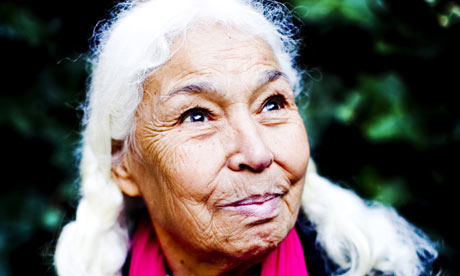
The Fall of the Imam is a novel by Nawal El-Saadawi, an Egyptian feminist writer and activist. I really hope this post makes you decide to read the book.
 |
| Nawal-El-Saadawi-001.jpg |
Additionally, Nawal portrays the mother and the daughter are the heroic and revolutionary figures who fight against the male dominated society. By doing this with such a poetic and mystical style, Nawal taught me how to love women and see them as strong. I do not now why it took a book to do that for me, but the message was so strong throughout the entire novel that it had a huge impact in making me appreciate the relationships between women in their struggle against patriarchy.
 |
| fall-imam.jpg |
She would have escaped had she not been halted by the smell of the land and the sea, bringing back her whole life in one moment. She halted, took a deep breath, and just at that moment the bullet struck her in the back and bored its way through like an arrow straight to her heart. She dropped to the ground, bleeding slowly. Her dog whimpered once and was silent, and the birds flew up in fright, filling the universe with their cries."
What is interesting about the recurring theme in these passages is that Bint Allah ("daughter of God") never really "dies." She continues to have consciousness and relates memories to this one moment throughout the book. This also shows that "Bint Allah" can be seen as an idea for liberation that cannot be killed.
Victimization and Empowerment:
I also appreciate how Nawal shows women as strong, even when they are in situations where they are the victims. For example in the chapter titled "The Imam and Bint Allah," the Imam tries to devour Bint Allah. Since he cannot do this intellectually (she will neither give into his demands for respect nor follow his patriarchal religion), he tries to physically devour her. The context of this scene leads me to believe he is raping her; however, Nawal shows how Bint Allah has power over the Imam because he cannot devour or conquer the part of her that he fears--her ability to challenge male dominion, which makes the Imam fearful and insecure, and eventually destroys the Imam.
He sat in front of her sucking her bones, cracking them like sticks of sugar cane and extracting the marrow from the inside, with his tongue and lips. She watched him as she would watch a sheep fattened for the Big Feast enter the butcher's shop, his eyes sinking into their sockets with fear, for in his eyes there was nothing but fear, a terrible fear. No matter how much he ate he was never satisfied and no matter how much he protected himself with all sorts of things he never felt secure. She handed him bone after bone, then gave him the shoulder blade followed by the rump and the spleen. His belly was full, swollen like a goat skin, but she continued to hand him one piece after the other until she heard the sound of an explosion and his face fell to the ground. His eyes opened wide with surprise as though he could not believe what was happening and she said to him in a bantering tone: It begins as a game and ends in ruin. Then she lept away, light-footed as a doe, with her dog running close behind her. (144-145)
This suggests that women, as a force that challenges patriarchy, cannot be killed or suppressed, even though individuals might be. In the above passage, it is interesting how Bint Allah willfully gives the Imam her "bones" to suck on. I think this is perhaps because she knows that she can destroy him with her intellect. It is as if her body is a trap that she uses to lure him towards death. She recognizes the Imam's desire to devour her as "game," which she plays along with, knowing that it will end in ruin for the Imam. In this sense, the rape is allegorical for all relations between patriarchal men and women and should not be thought of as a literal scenario where Bint Allah willingly allows the Imam to rape her.
I think the above passage is an extremely interesting depiction of rape. It seems like most male authors always focus on the sexual aspects of rape, which objectifies the victim, even if they are still trying to gain sympathy for the female character. However, Nawal associates the act with a self-destructive gluttony that shows how patriarchy itself is self-destructive because its repression creates females who challenge it. I also think that the metaphor of the Imam sucking the marrow out of Bint Allah's bones depicts the emotional and physical pain better than realistic accounts might. This is because rape is more than a physical action and therefore can only be accurately described in ways that illustrate the violence in physical, emotional, and spiritual ways.
Definition of Love:
One of the most beautiful aspects of the book Bint Allah's recollection of falling in love, described in the chapters, "Ecstasy of Love" and "Together in the Trench." Below is a passage from "Ecstasy of Love":
During the day I moved from one wounded man to the other, carrying a pot for urine and another for stools. At night I kept wide-awake straining my ears to catch a moan. I could see his face as he turned it towards me in the dim light. It was thin and pale and wan. Over his chest there was a deep wound and from his eyes looked out a tender yearning. In the dark of night I go towards him and say: Fadl Allah was at the war front, did you see him there? Is he alive? Who is Fadl Allah? he asked. Is he your husband? He is my milk brother and he was with me in the orphanage, I said. Then I fell silent. Why are you silent? he said. What shall I say? Tell me about yourself, he said. But what can I tell you? Tell me everything, he said.
But I did not know what to say. My life seemed full of secrets and yet when I started to talk it looked empty as though there was nothing in it to talk about. He surrounded me with his arms like a mother and whispered to me, Go to sleep, and as I slept all my fears slipped away from me. I began to talk about myself and each time I recounted something my tongue became freer and freer and my heart grew lighter and lighter. My body seemed to be flying like a body without weight. As I climbed higher and higher up the hill a gasp escaped my lips. I had always dreamt of going up to the top of the hill. For twenty long years, ever since I had been born, I had continued to see the hill between the river and the sea, there were my mother stood waiting for me. I could never forget the smell of the air, nor the damp earth under my palms, nor could I forget the tree and the rock and the slope of the hill rising up. Here was my land, my country. Its smells were the smell of my life, strong and penetrating. I opened my arms, filled my lungs with a deep breath of air like the first breath of life at the moment of birth, like the last breath of life at the moment of death. And for the first time since I was born I took in everything in one deep breath, the smell of the sea, of salt water, of iodine, of seaweed and molluscs and fresh fish. I abandoned myself to the sea air, let it seep into me, fill me up, drown me in its softness. Its white waves rose up in the night reaching to the sky, enfolding me like the arms of God. And he was by my side holding me in his arms and saying:
Do you like fish grilled on charcoal?
I love it.
Do you prefer the head of the fish or its tail?
I like both of them.
His laughter rang out, filling the universe like the laughter of children, like an oyster shell opening its lips to desire. The air of the sea filled her with a lust for life, with a deep hunger hungry for everything. All her senses were suddenly awakened like waves in wonderful turmoil. The stars glittering over the sea were like lighted pearls. The rustle of leaves, the sound of the waves, the whisper of the wind, joined in a single call going deep. Her black eyes opened wide in abandonment to the ecstasy of love, to the moment when everything else is excluded. Then when it is over, she closes her eyes and sleeps on his chest like a child being rocked slowly, and his voice wafted to her from a distance whispers: I love you. (83-84)
I think this passage captures the comfort of finding someone to listen to your story. In a society where most people do not care about one another, it is empowering to find someone who is curious and cares. Additionally, in a patriarchal society, where women and their stories are often silenced, he provides Bint Allah the opportunity to express herself.
Here is another beautiful passage from "Together in the Trench," a poetic chapter where Bint Allah reunites with her childhood friend Fadl Allah in a trench during a war:
She closed her eyes and said: I see you as though it was only yesterday when you left. I see you as you are, as you always have been. You have never been absent, you have always been with me. He closed his eyes and rested his head on her breast just as he used to do when still a child, then suddenly awakening opened his eyes and looked at her, seeing her as she was now, a woman. They were still in the trench and time had stopped moving. He put his arms around her, and the trench became too narrow for the two of them, too narrow for his arms stretching out to enfold her, too narrow for the vast universe, as vast as the burning disc of the sun up in the heavens. And she too wound her arms around him and the trench was now too narrow for her, for her to hold the universe in her embrace. And when light revealed them in the trench holding each other, they did not unwind their arms or move apart but held each other in a long embrace, their bodies slowly merging into one and the whole world stood still to watch a scene of love, to see two beings changing into one, never to part again, never afraid of the light, never afraid of death, for each of them had known what dying was. Now he and she were gone, lost in one another, dissolved. Now no force in the world could make them part again, neither the noise of guns and rockets all around nor the loud abuse of enemies or the whispers of their friends, nor the orders of the Imam or the Devil or the Chief of Security himself.
I opened my eyes and found myself standing in the trench alone with the letter folded in my hand. Where was Fadl Allah? I wondered. Where had he disappeared to? Had he died in the war? Had he died in prison? In the distance I could hear their panting breath draw nearer, their feet treading on the ground with the sound of their iron-heeled shoes. So I started to run in the dark of night, trying to save my life. They kept coming after me, their dogs yapping and barking behind them, and I kept on running, now knowing why I was running like this all the time. I had got as far as the spot where the hill begins to rise. It was just before the break of day and I was on the verge of giving them the slip when one of them took aim at me and got me in the back. My body continued to run a few steps, then fell to the ground, but before the letters of the alphabet had disappeared from my mind I said: He was my brother and he was with me in the children's home. Your sins are without end and shall be counted against you, in this world and in the world to come, I heard them say. You are a child of sin and so is he, and his name is not written either on the lists of Hizb Allah or on those of Hizb al-Shaitan.
I was running and the night was black as ever. I could hear them tread with their iron feet as they chased after me. I touched my belly with my hand, feeling for it in the night as I ran. It was round and smooth and loving, warm under my palm. His voice reached me, calling from a distance, sounding like the voice of my mother: Bint Allah, come here. He moved nearer to me until our bodies almost touched. I wound my arms around him and we locked in a tight embrace. A shiver like a strange fever went right through me deep inside. A voice whispered softly in the night: Fear not, I am God and you shall give birth to Christ. It was dark and I was still running with the letter held tightly in my hand. I hid it in my bosom when I heard them panting close behind. I delivered his letter to her. I will risk my life to save it. It is more precious to me than the most precious thing I have. I will risk being stoned to death, like the Virgin Mary who risked her life to give birth to her son, like my mother who died to bring me to the world. When I reached the place where the hill starts to rise upwards midway between the river and the sea, the smell of the earth came back to me. Suddenly I felt safe and just at the moment when I could have escaped I stopped to thank God for saving me. As I knelt in prayer they hit me in the back. They always strike me from behind and when I turn around to face them they quickly disappeared. They never look me in the face. Before I fell to the ground wounded in the back I said to myself. My belly was full of the fruit of love when I kneeled on the ground to pray, but I hear the Chief of Security say: Love does not exist, only the fruit of sin. (88-90)
The above passage illustrates how true love is forbidden in the patriarchal society. While it is overtly forbidden in the society Nawal illustrates, it is also forbidden in any patriarchal society because of the gender binary. Lovers have to challenge this binary in order to find true love and doing so breaks the rules of patriarchy.


